Summary and Review of The Other Half of Church
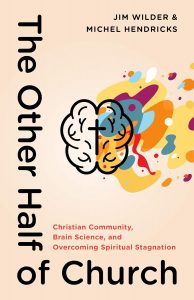
Title: The Other Half of Church: Christian Community, Brain Science, and Overcoming Spiritual Stagnation
Author: Jim Wilder & Michel Hendricks
Summary
The Other Half of Church is an excellent resource for discipleship. The authors focus on brain science, disputing the traditional thought of left-brained and right-brained people. They share that individuals receive information through the right side of their brains, and the information travels around to the left side where it is processed. The right side of the brain continually processes information faster than a human realizes, meaning, most of this information is processed subconsciously. Any information that travels to the left side of the brain is processed in a much slower, logical way.
Something that is highly stressed in this book is their finding that relational joy is key to making disciples. They argue that if a person does not feel joy, the information they process will not produce any change. In other words, information alone does not equal transformation. They call this “hesed” community. The ultimate goal, according to these authors, is to work at changing the way we think so that our knee-jerk reactions are to thinking and behave “Christianly.”
Interesting Pieces
Page 20-21 – The authors show a clear diagram and provide a thorough explanation of how information flows through the brain.
Page 23 – the authors offer a clear, concise definition of a discipleship: “the way to become the kind of person who does, easily and routinely, what Jesus said—does it without having to think much about it.”
Page 31 – When only left-brained Christianity is engaged, it creates a relational environment that is optimal for narcissism. The authors devote an entire chapter later in the book to narcissism in the Church.
Page 64 – in describing the value of levels of joy in an individual, the authors make a comparison to our blood pressure. An individual cannot decide to increase their joy or decrease their blood pressure. However, Joy levels are regulated indirectly through relationships. Increasing joy involves improving relational skills, training the brain, and getting involved in tightly bonded community.
Page 85 – The authors stress the importance of love in the discipleship process, rather than information transfer. They say, “When hesed replaces truth as the foundation of discipleship, the whole model self-corrects. Placing love at the core of the transformation process allows truth, choice, and power to play their proper roles and not bear a weight they were never intended to carry. Developments in modern brain science have made it clear that any model of transformation and character change must be anchored in the development of a love bond with God and His people.
Page 173 – In their chapter on Narcissism in the Church, the authors explain the difference between simple enemy mode (which we all fall into occasionally) and predatory enemy mode. In simple enemy mode, our relational circuits shut down and we want people and problems to go away. Our minds are locked on our problems. In conflict, we argue aggressively and will be quick to judge. However, in predatory enemy mode, the circuits that govern attachments are shut off, so bonds with others are shallow. In predatory enemy mode, relational circuits are turned on, but they are used for predatory advantage. These relational readings are used, not to show compassion but to exploit weaknesses. The predatory enemy mode tracks emotions of others in order to pounce.
Review
If you care deeply about discipleship, and especially if you have an interest in psychology, counseling and/or brain science, you will enjoy this book and it will certainly change the way you approach discipleship if this is the first time engaging this type of teaching. For most of the book, the primary author is Michel Hendricks, who is learning this “other half of the Church” from Jim Wilder. I appreciate their willingness to turn their findings and practices into book form for others to benefit from. Pastors and ministry leaders would do well to read this book and put their findings into practice.
Where to buy
You can purchase this book on Amazon.